The Fork That Actually Mattered
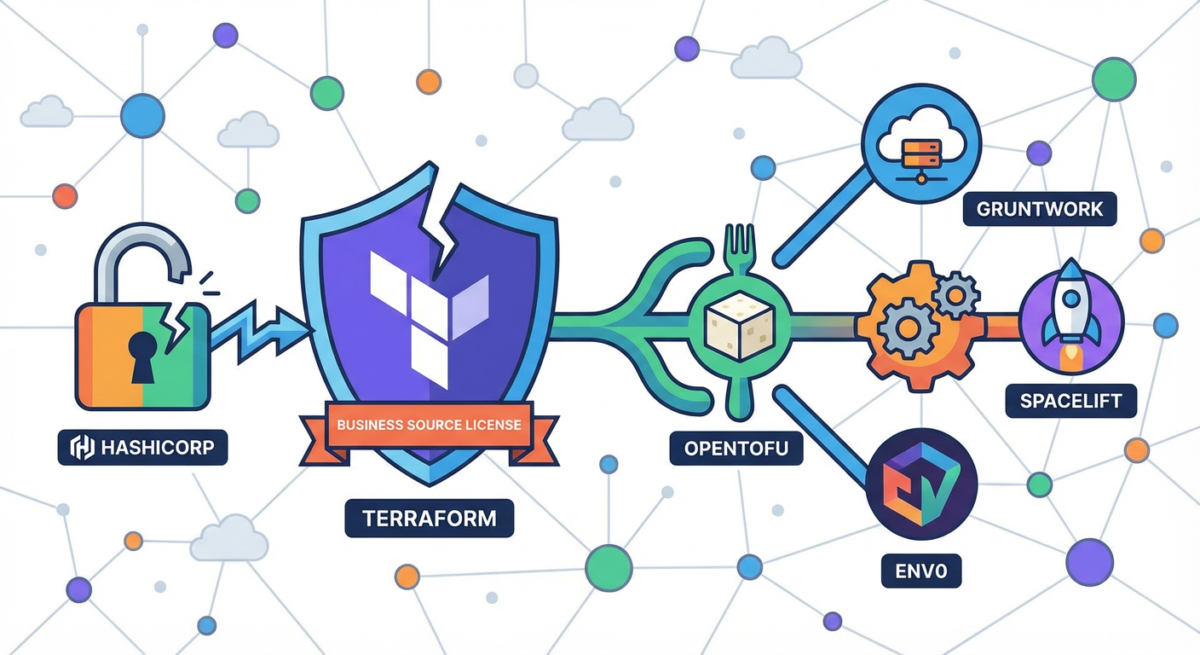
When HashiCorp moved Terraform to the Business Source License in August 2023, most of the industry watched with the detached curiosity of someone observing a distant corporate squabble. Then the Linux Foundation got involved. Then Gruntwork, Spacelift, and Env0—three companies with real skin in the game—started backing a fork called OpenTofu. That’s when you knew something had shifted in the infrastructure-as-code ecosystem.
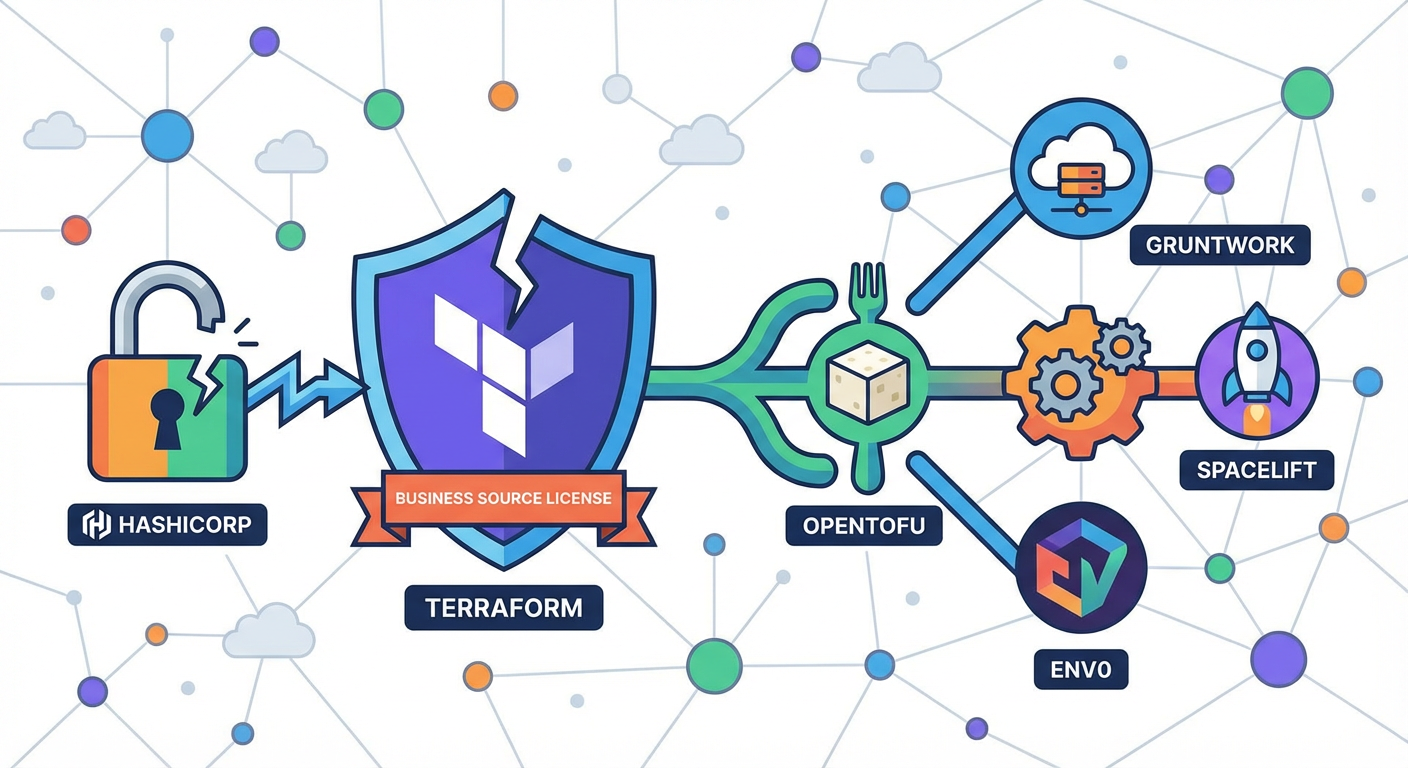
What makes this different from the dozen other open-source fragmentation events we’ve seen is the specificity of the grievance and the quality of the response. This wasn’t ideological posturing. Major infrastructure companies were saying: we cannot build products on top of a tool whose licensing terms might change overnight. They had something to protect, and they had the engineering talent to act on it. By late 2024, OpenTofu hit version 1.9 with features—provider-defined functions and early variable evaluation—that Terraform hadn’t shipped yet, even as Terraform sat constrained under BSL restrictions.
Understanding the Licensing Trap
The Business Source License isn’t quite open-source, and it isn’t quite proprietary. It lives in the legal equivalent of an uncanny valley. The terms restrict commercial use of Terraform for a period of time, meaning companies selling infrastructure services could no longer freely modify and deploy the tool. For a consulting firm or a managed service provider, this was paralyzing. You can’t ship code to clients when the license says you can’t.
HashiCorp’s reasoning was straightforward from a commercial perspective: open-source contributors were building billion-dollar companies on top of their work without paying anything. That’s not a bug in the open-source model; it’s the entire feature. But it was also unsustainable for HashiCorp shareholders. When a company reaches a certain scale and IPOs (or in this case, gets acquired), the pressure to monetize everything becomes relentless.
The fork forced the issue into the light. Restrict the license, and companies will fork. If they fork successfully, you’ve just created your own competition. Not a new lesson in open-source history, but HashiCorp learned it at expensive scale.
IBM’s November Acquisition and the Question Mark
Then IBM acquired HashiCorp in November 2024 for 6.4 billion dollars. Nobody quite saw that coming. IBM doesn’t have a track record of aggressive open-source monetization. Their entire cloud strategy depends on being seen as partner-friendly, as the company that understands enterprise complexity rather than the one squeezing margin from every angle. That creates an interesting dynamic.
The acquisition immediately raised a question in the community: will IBM reconsider the licensing stance? There’s no public signal either way, which is perhaps its own signal. What we do know is that IBM now owns a tool whose fork is outpacing it in feature velocity and whose user base is increasingly nervous about long-term direction. That’s not a comfortable position, even for a company with IBM’s resources. The market has spoken, and it said it prefers to trust a Linux Foundation-backed fork over a BSL-restricted tool owned by any single commercial entity, no matter how large.
The Adoption Numbers Tell a Story
Here’s where the data becomes almost comical in its clarity. According to the CNCF 2024 Cloud Native Survey results, Terraform remained the most widely used infrastructure provisioning tool at 60% adoption across the cloud-native community. That’s remarkable stability for a tool under this much uncertainty. But OpenTofu had already captured 17% adoption in less than a year post-fork. Think about that velocity. A fork of a mature project usually gets abandoned within months. OpenTofu is gaining real traction.
Meanwhile, Pulumi—the alternative infrastructure-as-code platform that lets you write infrastructure in general-purpose languages instead of HashiCorp Configuration Language—reported 200% year-over-year growth in enterprise customers through 2024. Pulumi directly benefited from the licensing chaos. Every company that said “maybe we should diversify away from Terraform” looked at Pulumi, and many of them stayed. That’s the hidden tax of the BSL experiment: not just fork adoption, but market share migration to completely different categories of tooling.
For organizations with thousands of lines of Terraform code, switching to Pulumi is genuinely painful. You’re not just changing tooling; you’re rewriting. Yet enough people have decided that pain is worth the security of knowing their infrastructure platform won’t be yanked into some restrictive licensing model.
What This Means for Your Decisions Right Now
If you’re starting a new infrastructure project, the honest answer is that both Terraform and OpenTofu are viable. But the question you should ask yourself is about risk tolerance. With Terraform, you’re betting that IBM’s ownership will result in a more permissive licensing posture eventually, or you’re accepting the BSL restrictions as a permanent part of the architecture. With OpenTofu, you’re betting on Linux Foundation governance, which has its own limitations but at least has a track record of not springing surprise licensing changes on you.
For teams already deep in Terraform, you’re not in immediate danger. Your existing code runs fine. The real pressure point comes when you need to build commercial products on top of your infrastructure code or when you’re making architectural decisions about tooling five years out. That’s when the licensing question becomes concrete.
The most interesting move right now is IBM’s next step. If they signal that Terraform will return to truly open-source licensing, even a weak signal, the fork war probably ends quickly. OpenTofu demonstrated that the community could execute, and that was enough to create leverage. But if IBM maintains the BSL status quo, we’re probably looking at a permanent split in the ecosystem. Not because OpenTofu is dramatically better—though 1.9’s feature set is respectable—but because community trust, once broken, takes years to rebuild.
For the latest developments in this space, check the OpenTofu official project and changelog and keep an eye on HashiCorp’s public statements under new ownership. The infrastructure-as-code ecosystem is at an inflection point, and watching how these companies navigate it will tell you a lot about where enterprise tooling is headed. What’s your take on how this should resolve?
