
The Numbers Don’t Lie, But They Do Hurt
Every time a major vulnerability drops, there’s this ritualistic dance. Security teams scramble. DevOps folks refresh their Slack channels at suspicious intervals. Someone’s boss asks “are we affected?” in a meeting that could have been an email. Then, roughly 48 hours later if you’re unlucky, someone has already weaponized it. That timeline isn’t hyperbole anymore. The Open Source Security Foundation’s latest review confirmed that high-profile vulnerabilities in npm packages are being actively exploited in under two days. Meanwhile, the volume of critical CVEs in the npm ecosystem jumped 28 percent year-over-year. If you’re the type who likes to sleep at night, that’s a difficult pill to swallow.

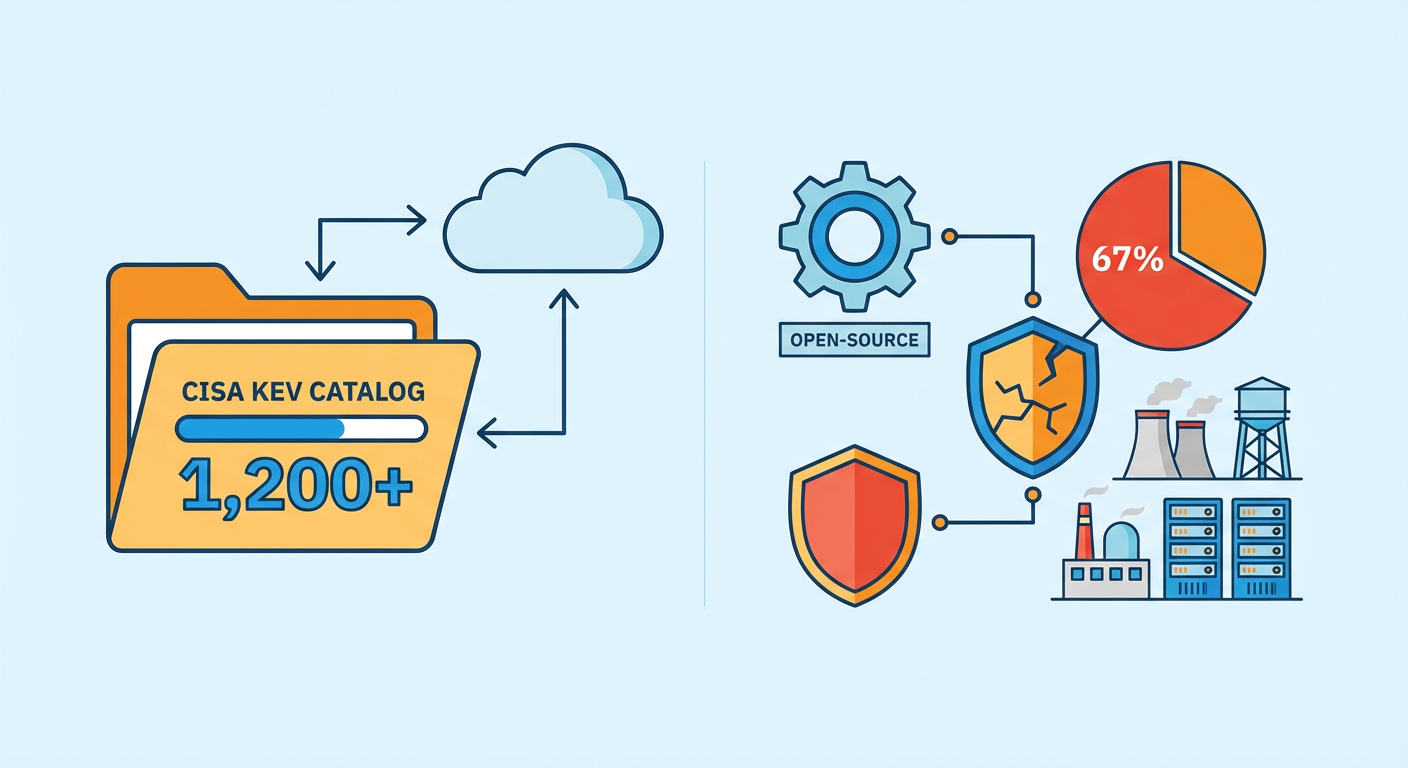
What makes this worse is the sheer scale of exposure. The CISA Known Exploited Vulnerabilities Catalog has crossed 1,200 entries as of end of 2025. That’s not a number. That’s a library of failure. And here’s the part that should genuinely worry your leadership: 67 percent of successful breaches targeting critical infrastructure involved at least one open-source component. Think about that for a moment. Your on-prem systems, your cloud deployments, your microservices architecture, your containerized workloads. All of them are running open-source somewhere in the stack. And statistically, if someone breaches you, they came through that door.
The Supply Chain Became the Battlefield While We Weren’t Looking
There’s a reason security vendors have pivoted hard toward supply chain defense. It’s elegant from an attacker’s perspective. Why spend resources compromising individual organizations when you can compromise a single widely-used package and watch the blast radius multiply automatically? The math is just too good. According to the Sonatype State of the Software Supply Chain Report, malicious package uploads increased 156 percent compared to 2024. That’s not a gradual trend line. That’s exponential growth in the baseline threat. And the most reliable attack vector remains almost laughably simple: typosquatting. Register a package name that’s one character off from something popular, wait for the tired developer copying from Stack Overflow at 11 PM, and you’ve got foothold.
Socket.dev reported that in a single quarter of 2025, they blocked over 10,000 malicious packages from reaching developer environments. Ten thousand. In three months. From one security vendor. That tells you the volume of trash flowing through the system is staggering. Most of these never make headlines because security teams catch them before the compromised code ever executes. But the ones that slip through? Those become CVE-XXXXX stories. Those become the 3 AM incidents where someone rewrites the incident log four times before sending it to leadership.
Compliance Theater vs. Actual Security
Here’s where I’d normally expect things to get optimistic. Surely the industry has solved this by now. We have frameworks. Google’s SLSA (Supply-chain Levels for Software Artifacts) framework hit version 1.1 in 2025. It’s sophisticated. It’s well-designed. It actually works if you implement it properly. And yet. Fewer than 12 percent of major open-source projects have achieved even SLSA Level 1 compliance. Level one. The entry-level bar that basically says “you have some controls in place.” When I first saw that number, I had to read it three times. Because it meant that the projects most organizations depend on are operating at the trust-but-verify layer at best.
The problem is structural. Open-source maintainers are often overworked volunteers operating on the goodness of their hearts and the generosity of corporations using their work commercially. Asking them to implement supply chain security controls is like asking a charity to hire a full-time compliance officer. Theoretically correct. Practically impossible. So you end up with this weird equilibrium where the frameworks exist but adoption doesn’t follow. Enterprise organizations check the compliance box without understanding what they’re actually certifying. Maintainers ship code without the formal guarantees that would make distribution truly secure.
What Actually Matters Right Now
If you’re running production systems, you can’t wait for the industry to collectively fix itself. That’s not cynicism. That’s experience talking. You need to operate in the world as it exists, not as it should exist. Start by inventorying your dependencies like your career depends on it. Because it might. Understand every transitive dependency your code pulls in. Use tools that can actually see inside your supply chain instead of just surface-level scanning. Automate the boring parts so your team can focus on judgment calls instead of checkbox exercises.
The second part is harder but more important: assume something will get through. Your monitoring isn’t perfect. Your supply chain controls aren’t perfect. Your vendors aren’t perfect. So build detection at runtime. Implement runtime application self-protection. Segment your network so a compromised dependency doesn’t become a full infrastructure compromise. Use containerization isolation properly instead of treating it like a packaging convenience. Make it expensive for an attacker to convert a foothold into a breach.
The Real Problem Is Cultural
Technically, we know what needs to happen. Signed artifacts. Verified checksums. Reproducible builds. Transparent dependency trees. Automated compliance gates. Most of this technology exists and works. But between knowing what should happen and having it actually happen in production at scale is a chasm filled with budget constraints, competing priorities, and the eternal belief that “we’re probably fine.” CVE-2025-XXXXX is proof that we’re not fine. It’s the millionth proof at this point. And somehow the industry keeps acting surprised.
The uncomfortable truth is that supply chain security requires sustained investment from organizations that have other fires to put out. It requires maintainers to have resources they don’t have. It requires developers to slow down slightly to check what they’re pulling in. It requires DevOps teams to add friction to deployment pipelines. None of that is exciting. None of it shows up on a roadmap as a feature. But the alternative is accepting that every system you deploy has been compromised before it left the repository. At some point, that stops being acceptable.
What’s your current supply chain posture? I’m genuinely curious whether the teams reading this have implemented real controls beyond the compliance checklist. Drop a note in the comments or hit me on the socials. I’m collecting data on how actual organizations are responding to this shift, and I’d rather hear from people in the trenches than read another analyst report written by someone who hasn’t ssh’d into a production server since 2019.
