The Signal From the Noise: Graviton4 Is No Longer the Alternative
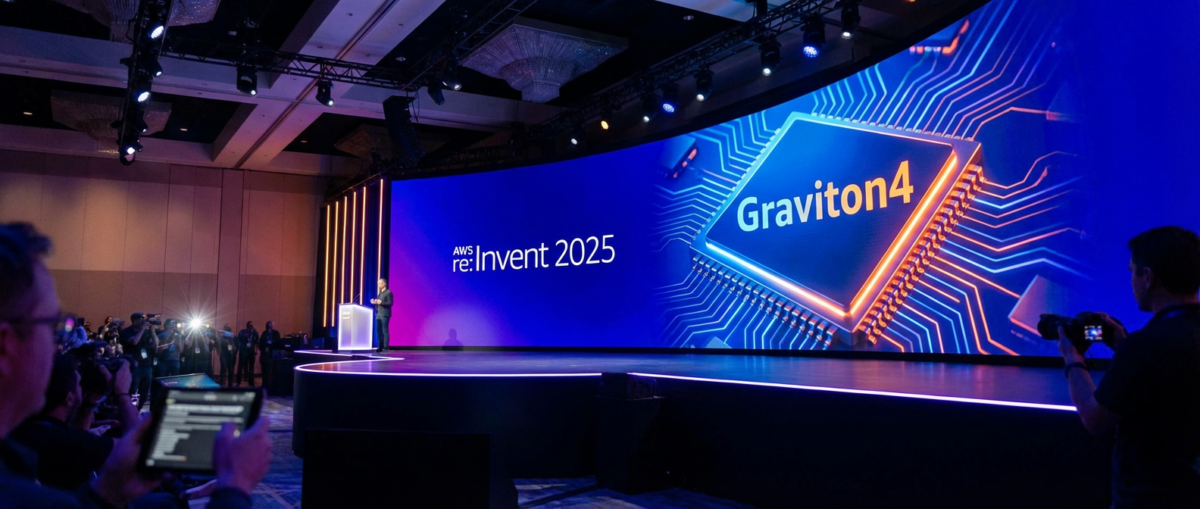
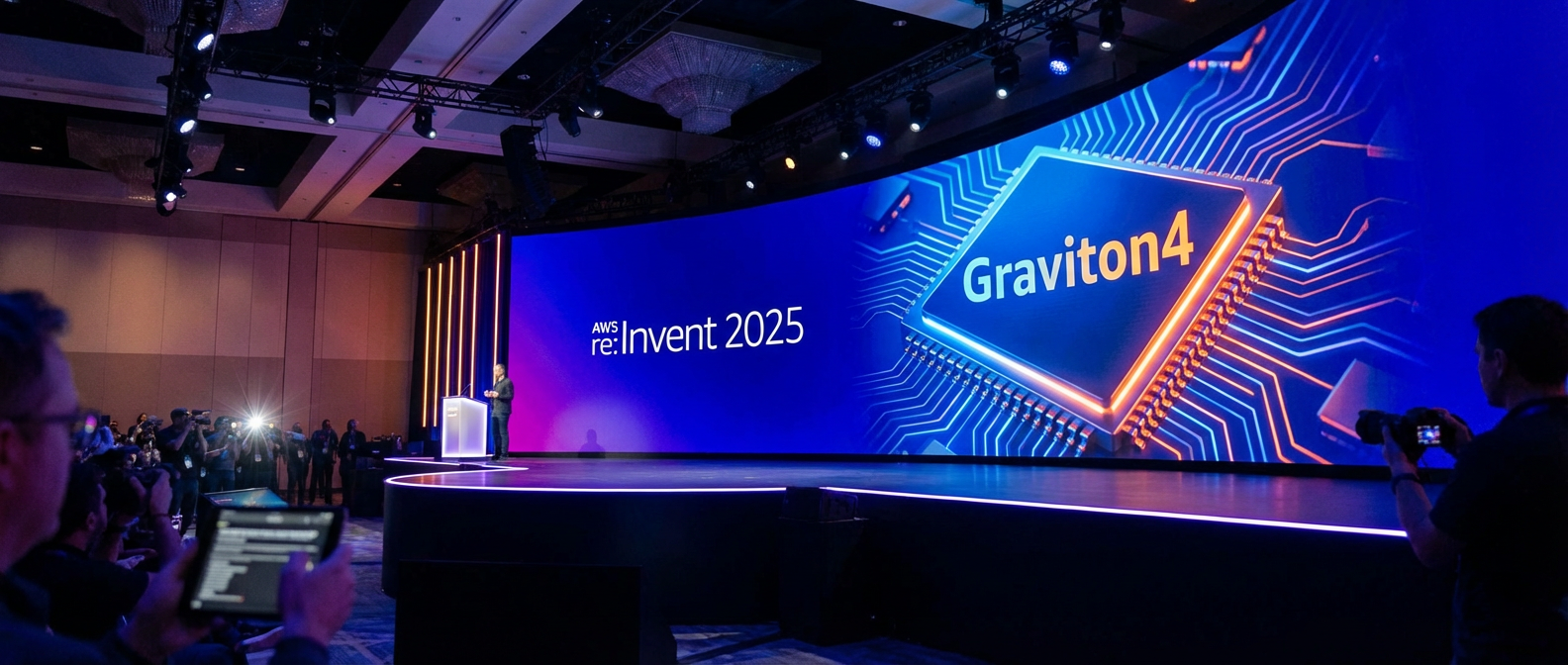
Amazon showed up to re:Invent 2025 with receipts. Not the aspirational roadmap kind, but the operational kind: Graviton4-based instances now account for over half of all new EC2 launches within AWS’s own infrastructure. That number should make you sit up straight. This isn’t marketing theater about “future potential” or “emerging workloads.” This is a hyperscaler saying, after years of optimization work, that their own engineers and customers are choosing ARM at scale when it matters most.
I’ve watched enough technology cycles to recognize when something shifts from “interesting experiment” to “infrastructure inevitability.” The Graviton rollout has that texture. What started as a curiosity in late 2021 has become the path of least resistance for a significant portion of AWS’s computational fleet. That’s the signal worth paying attention to, separate from whatever keynote spin accompanied the announcement.

Price-Performance Economics Are Getting Harder to Ignore
Let’s talk numbers, because numbers don’t lie and they’re the only thing that matters when you’re explaining a migration to finance. AWS benchmarking documentation released in late 2024 showed that Graviton4 instances deliver approximately 30% better price-performance on compute-intensive workloads compared to equivalent x86 offerings. That’s not marginal. That’s not “wait and see.” That’s move-your-workload territory for anyone running containerized services, batch processing, or stateless microservices at any reasonable scale.
The economics compound. If you’re running a thousand instances, that’s roughly one-third fewer instances you need to buy, or one-third more throughput from the same bill. Most engineering teams I know would sprint a quarter to find that kind of efficiency gain through code optimization. Yet infrastructure change often gets treated like a burden rather than an opportunity. This feels like an inflection point where that calculus might finally shift.
Production ARM Adoption Is Real, and Growing Faster Than We Assumed
Here’s where the data gets genuinely interesting. The CNCF Annual Survey 2025 found that 38% of respondents now run at least one ARM-based workload in production, up from 21% in 2023. That’s not gradual adoption. That’s not “early adopters dabbling.” That’s nearly four in ten organizations crossing the threshold into mixed-architecture operations within two years. The trajectory matters more than the absolute number here. This is accelerating.
What’s particularly notable is that these organizations aren’t mostly the usual suspects, the hyperscalers and bleeding-edge infrastructure companies. They’re enterprises, mid-market teams, startups trying to optimize their cloud spend. They’ve done the migration work. They’ve solved the problems. And they’re staying. That’s the conversion signal that actually predicts sustained adoption.
The Real Friction: Developer Tooling and Third-Party Dependencies
But here’s where I need to pump the brakes slightly and talk about the friction that’s still real. Docker’s multi-platform build tooling (buildx with BuildKit) showed a 60% increase in multi-architecture image builds throughout 2025, which sounds positive until you realize it also indicates an enormous surge in developers frantically trying to ship containers that work on both architectures. That’s not always enthusiasm. Sometimes that’s panic.
The sharp edge is worse: third-party C-extension Python packages that haven’t shipped ARM wheels remain a documented pain point. Datadog’s engineering blog surfaced this in 2025 when they documented silent runtime failures in migrated Lambda functions caused by packages falling back to source compilation or simply refusing to install on ARM. You migrate your function, it passes your tests in a comfortable x86 container, you deploy to Graviton-backed Lambda, and suddenly it crashes at 3 AM because some transitive dependency doesn’t have a pre-built wheel. I’ve been there. It’s not fun.
The ecosystem is catching up, but unevenly. Some package maintainers have been aggressive about ARM support. Others haven’t. There’s a long tail of legacy packages that will probably never get updated. If you’re migrating a complex application with a deep dependency tree, ARM compatibility becomes a discovery process that feels more like an obstacle course than engineering work.
The Conversation We Actually Need to Have Now
What makes re:Invent 2025 different is that ARM in production has stopped being a question of “if” and become a question of “when” and “how much.” The 50% adoption rate within AWS’s own fleet, the documented price-performance advantages, and the actual production deployments across the industry mean that architecture decisions that seemed optional two years ago are now strategic.
The real conversation isn’t whether to adopt ARM. It’s about systematically managing the transition: auditing your dependency trees, testing your applications on ARM-based instances before migration, establishing ownership of multi-architecture support within your team, and being realistic about timeline. Some workloads migrate trivially. Others require genuine work. Most of them benefit from it once you’re through.
The other piece worth considering is that this is no longer primarily about cost optimization or theoretical future-proofing. It’s about participating in the infrastructure that large portions of the industry are already standardizing on. That network effect matters more than most people acknowledge. If you’re not at least experimenting with ARM in a controlled environment, you’re making a choice to lag the trend. Sometimes that’s the right call. Usually, it’s just inertia.
What’s your environment look like? Are you running any ARM workloads in production, or is this still on the roadmap for your team? I’d be genuinely curious to hear what specific blockers are holding you back, because I suspect the friction points vary widely across different application architectures and dependency profiles.
