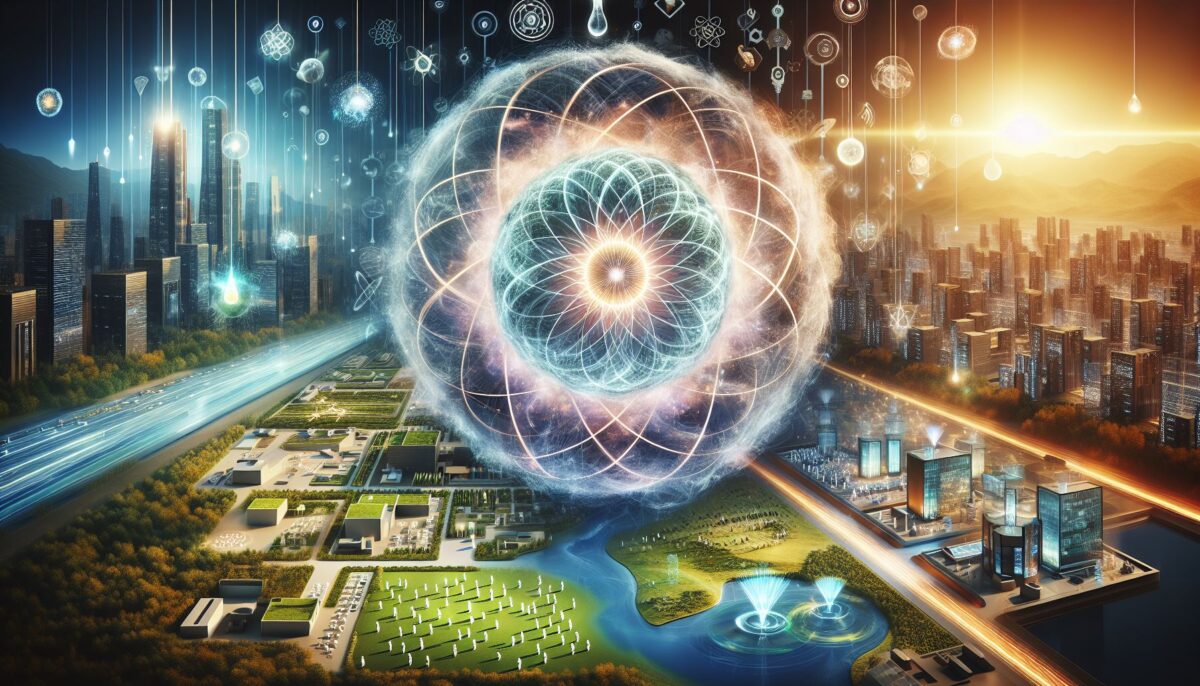
Hey tech enthusiasts and future-obsessed dreamers! Today, I want to talk about something that’s been making waves in the scientific community lately: nuclear fusion. Yep, that’s right—the energy source of the stars. We’re talking about the real potential for nearly limitless clean energy. If you’ve ever dreamed about a future where energy scarcity and climate change are just stories from the past, then fusion might be our best shot.
Fusion: A Star’s Best Kept Secret
Let’s start with what fusion actually is. Nuclear fusion is the process of combining lighter atomic nuclei to form a heavier nucleus. This is the same process that powers our sun and releases massive amounts of energy. Unlike nuclear fission (which is what’s used in our conventional nuclear reactors), fusion doesn’t produce long-lived radioactive waste. Instead, it uses isotopes of hydrogen, primarily deuterium and tritium, which are readily available, especially in the oceans.
For decades, scientists have been trying to harness this incredible process for a practically inexhaustible energy supply on Earth. But the universe loves its mysteries and didn’t exactly hand us the operating manual on fusion reactors ready to go. It’s been a challenge that’s teased and frustrated physicists around the globe for over half a century.
A (Not So) Brief History of Fusion Research
The quest for fusion has been a bumpy ride. Research began in earnest in the mid-20th century, with various countries pouring resources into it over the decades. You might’ve heard of a few key players like ITER in France or the National Ignition Facility in the United States. These are massive projects aiming to not just advance our understanding but to actually achieve what’s called “ignition,” where the energy produced by the fusion reaction equals or exceeds the energy required to sustain the reaction.
Now, I don’t know about you, but growing up I always imagined the year 2020 would look a bit more like “The Jetsons” than it actually did. It seems like for every leap forward, we’re met with setbacks or pauses for breath. But in recent years, it feels like we’ve truly entered a new phase where the pace of development is picking up speed.
Recent Breakthroughs: Real Momentum or Just Hype?
So, why am I bringing this up now? Recent breakthroughs have put fusion back in the spotlight. Last year, the National Ignition Facility actually achieved a net energy gain from a fusion reaction for the very first time. That’s right—more energy came out than was put in. If that doesn’t get you excited, I don’t know what will.
And they’re not alone. Private companies are also getting in on the action. Companies like Commonwealth Fusion Systems and TAE Technologies are making big promises and attracting capital like honey attracts bees. These startups are pushing new technologies, like using high-temperature superconductors in magnetic confinement techniques, to reach those elusive break-even points faster than big government projects might.
Why Should We Care? The Implications are Earth-Shattering
Let’s break down why these developments should have you bouncing off the walls with excitement or at least a raised eyebrow of curiosity.
Clean, Green, and Virtually Infinite
First and foremost, fusion is clean energy. It doesn’t belch out carbon emissions or produce long-lived nuclear waste. It’s like striking gold in the quest to reverse climate change and turn the tide in our favor. Imagine a world where our oceans can fuel our power needs, pushing fossil fuels to the dusty shelves of history.
Economic Boon
Here’s another kicker: think of the economic implications. Cheap, abundant energy could revolutionize industries, lower costs, and spur innovation similar to post-industrial revolutions of the past. Futurists are buzzing with predictions of a new golden age, where energy abundance could tackle issues like water scarcity through desalination or catalyze space travel through more sustainable propulsion methods.
Energy Independence
If all goes as planned, fusion could liberate nations from energy dependencies. Picture a world where access to energy isn’t dictated by geopolitics. Instead, countries could harness their own limitless power without the shadow of oil embargoes or pipeline politics looming over them.
The Roadblocks: Challenges We Must Overcome
Not to be the bearer of bad news, but it’s important to address the hurdles that still stand in our way.
Technological Challenges
The gap between having a successful experiment and deploying a commercial-scale reactor is huge. It’s the scaling-up process that proves challenging. We need materials that can withstand extreme conditions and massive investments in infrastructure.
Economic Viability
The economic model of fusion is still tricky. The funds needed to build these reactors are enormous, and without a clear path to profitability, investors can be understandably hesitant. Governments and private entities need to find a balance in collaboration and competition to move the industry forward.
Public Perception and Policy
There’s also the hurdle of public perception. Nuclear anything tends to send folks running for the hills. Education and transparent communication will be key to gaining the public’s trust and governmental support.
Looking to the Future: Hopeful Speculation
Now let’s indulge in some speculative forward-thinking. If we keep up this pace, it’s conceivable we could have functional, grid-ready fusion reactors within the next 20 to 30 years. That’s enough time to perfect renewable technologies and smoothly integrate fusion into our energy grids, phasing out fossil fuels without throwing society into chaos.
The prospect of fusion inspires me. It’s a testament to human ingenuity and resilience. We’ve got a shot at a brighter (no pun intended) future. I, for one, can’t wait to see how these stories unfold.
In closing, continue to keep an eye on those headlines coming out of labs and startups. Today’s news might be tomorrow’s historical moment. Until then, power on, dreamers and thinkers!
Cheers to the Engines of the Stars!
